You produced the content, did the outreach and landed the links – so why hasn’t your brand seen any impact?
For many brands, backlinks may feel like a magic tap that they can turn on and off whenever they need. They believe links equals more authority which equals more traffic and more growth – and fast.
While backlinks are one of the most powerful signals search engines use to understand credibility and relevance, building a healthy and powerful backlink profile requires lots of work.
Backlinks are a core part of any PR campaign, and every media mention or link has the potential to become a digital asset that could positively impact your brand for a long time.
But, the (sometimes uncomfortable) truth is that backlinks don’t always move the needle when it comes to visibility.
You may have been trying to tackle your SEO and digital PR for a while but with no luck. If you are finding yourself thinking ‘why are my backlinks not making any impact?’ then it's time to pay attention to just how your strategy could be failing you.
Some links don’t build visibility, some don’t deliver on trust and authority, and some won’t help your rankings. We all know by now that building your backlink profile can’t simply be a numbers game, there needs to be real strategy in order to truly benefit your brand’s online visibility.
It's important to understand your PR and link building objectives first, as this will then inform what success looks like for your brand.
If you are building your backlink profile but are noticing no increase in referral traffic, no boost to your domain rating and no rankings improvement, then you are likely making some of these common mistakes.
What’s in this article:
- How do backlinks impact SEO?
- Five reasons your backlinks might not be working
- Your backlinks aren’t relevant
- You haven’t built credibility and authority
- You have too many spam links
- You need to diversify your links
- You need a stronger backlink strategy
- Key takeaways
How do backlinks impact SEO?
Backlinks are one of the most important factors in SEO. They’re essentially links from other websites pointing to your content and they act as endorsements. When a reputable site links to you, search engines interpret it as a signal that your content is trustworthy and valuable.
Not all backlinks carry the same weight though. A link from a respected news site or an authority in your industry is far more influential than a link from an unrelated or low quality site. It’s a bit like professional recommendations – the more credible the source, the stronger the endorsement.
Backlinks benefit SEO in a few different ways:
1. Boost authority:
High quality backlinks signal to search engines that your site is an authority in its field, which can improve your rankings.
2. Driving referral traffic:
Backlinks also bring real visitors to your site, increasing exposure and potential conversions.
3. Speeding up indexing:
When a new page receives backlinks, search engines can discover and index it more quickly.
When it comes to backlinks, the focus should always be on quality rather than quantity. A small number of authoritative, relevant backlinks will have far greater impact than numerous low-quality links. Attempting to manipulate backlinks through spammy tactics can harm your rankings rather than help.
So, in short, backlinks are a key signal of trust and authority. When used strategically, they not only strengthen your SEO but also help connect your content with a wider, engaged audience.
Five reasons your backlinks might not be working
1. Your backlinks aren’t relevant
The relevancy of the links you’re building will have a direct impact on how helpful those links really are.
The idea of ‘relevancy’ can be pretty vague, and understanding it in the context of digital PR strategies can be complex. Essentially, relevance in digital PR is about telling stories on the topics that it makes sense for your brand to talk about.
Think about where you are pitching your PR content. Consider:
- Does your brand have the expertise to add to this publication?
- Would the audience of your product / service also read his publication?
- Does the publication have journalists that specialise in your niche? (For example travel journalists, motoring journalists, money saving journalists etc.)
- Has the publication published other stories on the same topic?
Prioritising relevancy does present a slight issue for some brands, as being too focussed on this can mean you pigeon-hole your brand and are unable to reach new audiences. For example, a company which provides car leasing services only pitching content around car leasing is going to get pretty boring, pretty quickly.
Instead, think about your potential audiences. Most people in the UK drive a car, and national news publications have specialised motoring journalists who are constantly looking for new, exciting content. So, think about how your brand can offer expertise on an issue many drivers are facing, like de-icing your car in winter:

The story includes timely, helpful advice from the brand’s resident expert, with a branded link within content that leverages the brand’s expertise in their topic area of motoring.
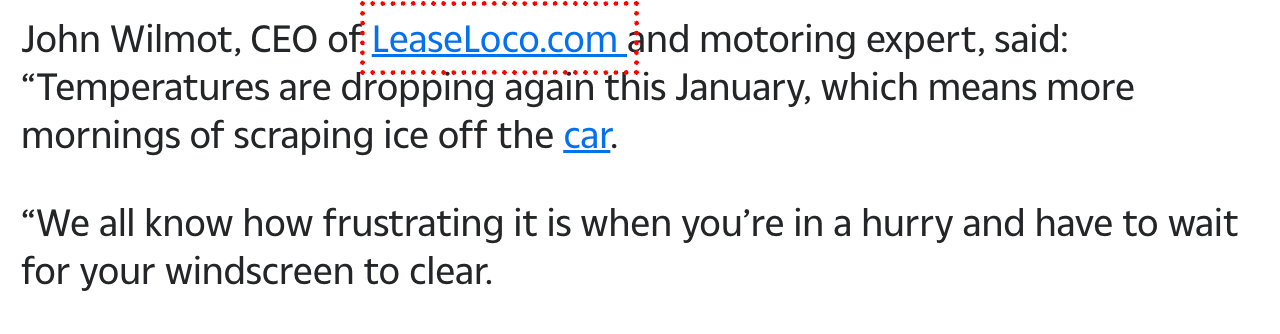
You can read more about our work with LeaseLoco in our case study here.
2. You haven’t built credibility and authority
With the rise in AI-driven search and a move towards GEO (Generative Engine Optimisation), credibility is more important than ever.
PR agencies and brands have changed strategy and are no longer focussing on building mass links with no real strategy. Now, the links your brand receives really matter, and the volume isn’t as important. Traditional ‘link building’ PR is long gone, and the focus is now on brand-building, quality media placements.
PR agencies and brands have changed strategy and are prioritising real quality.
One of Ahref’s top takeaways from a study that looked into factors that correlate with brand appearance in AI overviews was that branded web mentions played the most important part. This strongly aligns with what we are seeing across the industry, less of a focus on the number of links and more importance placed on credibility, relevance and authority of those media placements.
AI models are trained to use content from authoritative, verified sources. So when it comes to increasing your brand’s online visibility, it's important to pay attention to where you are pitching your content to. Make sure to source any data and use named experts within your PR content to establish authority and credibility.
If you are keen to understand more about GEO, read our previous blog post: What is GEO?
3. You have too many spammy links
Spam links are those created primarily to manipulate search performance for brands rather than to really provide any genuine value. Rather than pitching an interesting and relevant story to a journalist, these links are not earned through relevance or credibility. They usually exist for the sole purpose of influencing search engines and algorithms.
Backlinks are used by Google to determine your site’s ranking and trustworthiness. While strong relevant links can strengthen your visibility in search engines. Links created through manipulative tactics will be either ignored or devalued by Google’s ranking systems.
Some examples of spam links include mass guest posting, paid-for links, low-quality sites and links from irrelevant directories. Though a single low-quality spam link may not cause much harm, repeated or systematic activity will.
Spam links are one of the most persistent causes of long-term SEO damage. But, with the rise of AI-driven search, spam links are no longer just a risk to your SEO and backlink profile, but are a wider risk to your brand’s credibility.
Spam links are no longer just a risk to your SEO and backlink profile - they are a risk to your brand’s credibility.
AI-powered search tools work by evaluating authority and trust signals of online information. They tend to source credibility at a broader level than traditional rankings. LLMs may just ignore low-quality backlinks for ranking purposes, but persistent patterns of spammy behaviour could impact how trustworthy a site seems. Overall, keeping your backlink profile clean and well-contextualized helps protect rankings and visibility in AI-driven search results.
Similarly, Google often ignores low-quality links without affecting your rankings. What Google will notice is any emerging patterns, so if your backlink profile shows any signs of manipulative link building it may weaken your trust signals or trigger manual actions from Google. Most spam links don’t require any action, so if you have received links from sites you worry may be spam then don’t panic. Just focus on ways to improve your backlink profile and work on building authority and credibility rather than just upping your link numbers.
4. You need to diversify your links
A strong and effective backlink profile is not just made up of one type of link. A healthy backlink profile incorporates a mix of no follow links, follow links and brand mentions.
If every link going into your site were a dofollow, that would raise a massive red flag for Google and AI-generated search tools. The suspicion would be that these links have been paid for rather than earned, which goes against every PR practice. If a batch of the same sort of link suddenly appears it will send alarm bells and create an unnatural backlink profile and in some cases could cause your site to be taken off search engines altogether.
In order to gain a natural mix of links, you must diversify your outreach targets. A healthy profile will include a mix of links from National media, niche industry publications and regional titles.
The variety mirrors the way naturally authoritative brands show up online, and will do wonders for your own brand’s search visibility.
5. You need a stronger backlink strategy
When it comes to making sure your website has the most effective backlink profile possible - it really just comes down to having a strong strategy. This is because backlinks don’t work in isolation, they are most impactful when working as part of a wider brand strategy.
A PR agency can really help you here, and use years of expertise to hone in on what is going to work best for your brand.
Some of the most impactful ways to build your backlink profile include:
- Expert commentary: A good PR strategy will include an expert comment arm, as contributions to media discussions is essential to raising brand awareness, building authority and developing strong relationships with the media.
- Passive link building: Focus on creating content that is so valuable others will want to link to it on their own without being asked. Spend less time mass-creating content and sit back and enjoy the passive links.
- Building the right links: Strategic PR strategies will prioritise and think about which pages need authority to rank, which categories drive revenue and what keywords are causing you to be stuck on pages 2-3.
- Pitching content to relevant journalists: Pitching content relevant to your brand will not only make journalists more likely to cover your stories, but overtime search engines will associate your brand with those topics and improve rankings.
Key takeaways
- Backlinks alone won’t drive visibility without strategic authority: Links on their own won’t move the needle. You need relevance, credibility and a wider brand and SEO strategy in order to help your link profile.
- Numbers don’t matter, relevance and credibility do: A small number of strong, contextual placements in the right publications will outperform a larger amount of low-quality links.
- A healthy backlink profile is a diverse one: Spam links and unnatural activity are going to hinder your efforts to show up in both traditional SERPs and AI-generated content.
To learn more about how a strong PR strategy could help your brand, please get in touch.
© MOTIVE

.jpg)
.jpg)
.png)