The digital PR industry is evolving faster than ever. Over 75% of digital PRs say AI has fundamentally changed the way they work – from ideation and content creation to tracking visibility. At the same time, the media landscape has shifted. Newsrooms are shrinking, audiences are consuming news across a growing range of platforms, and social media is increasingly replacing traditional search – especially among younger audiences. Large language models (LLMs) are also changing how people discover information and reshaping PR objectives.
Despite these rapid changes, confidence in digital PR remains strong. Almost 70% of professionals say digital PR is more effective than it was a year ago, while 60% of PR firms expect growth over the next 12 months. The industry itself is expanding too. Currently valued at $115 billion, it’s expected to exceed $160 billion by 2031. But PR professionals must continue to navigate the challenges.
This blog explores the latest digital PR statistics across AI adoption, digital PR, media relations, and performance, offering a snapshot of how the industry is adapting, and where it’s headed next.
What’s in this article:
- Statistics on how AI is reshaping PR in 2026
- Statistics on media consumption 2026
- Statistics on digital PR and link building in 2026
- Statistics on media relations and the realities of pitching in 2026
- Statistics on PR performance in 2026
- Statistics on the future of PR
Statistics on how AI is reshaping PR in 2026
Artificial Intelligence (AI) is rapidly evolving and having a profound impact across nearly every sector of modern society, and the public relations industry is no different. Over the past 12 months many PR organisations have begun to adapt to the new technologies. Muck Rack reported on the state of AI in PR for 2026 and found the following statistics:
- 51% of PR pros say they now work somewhere with an AI use case policy. This is up from 21% in 2024.
- 43% of PR pros say their work now offers AI training, up from 21% in 2024.
- 75% of PR pros are using a paid AI service – a huge jump from the 57% of professionals using paid services in 2024.
- Organisations are becoming more open to AI. Only 4% of professionals say they work somewhere that actively restricts or discourages AI use.
- Further highlighting the openness to new AI technologies, 63% say their workplace encourages them to experiment with generative AI.
One term that’s become important is Responsible AI. It’s going to be critical for several reasons, chief among them being the need to ensure fairness, accountability, transparency, and safety in AI applications. Despite this growing importance, organisations are still at varying stages when it comes to formalising these principles as Meltwater found – only 36.2% say their company has a formal policy in place for ethical and effective AI usage.
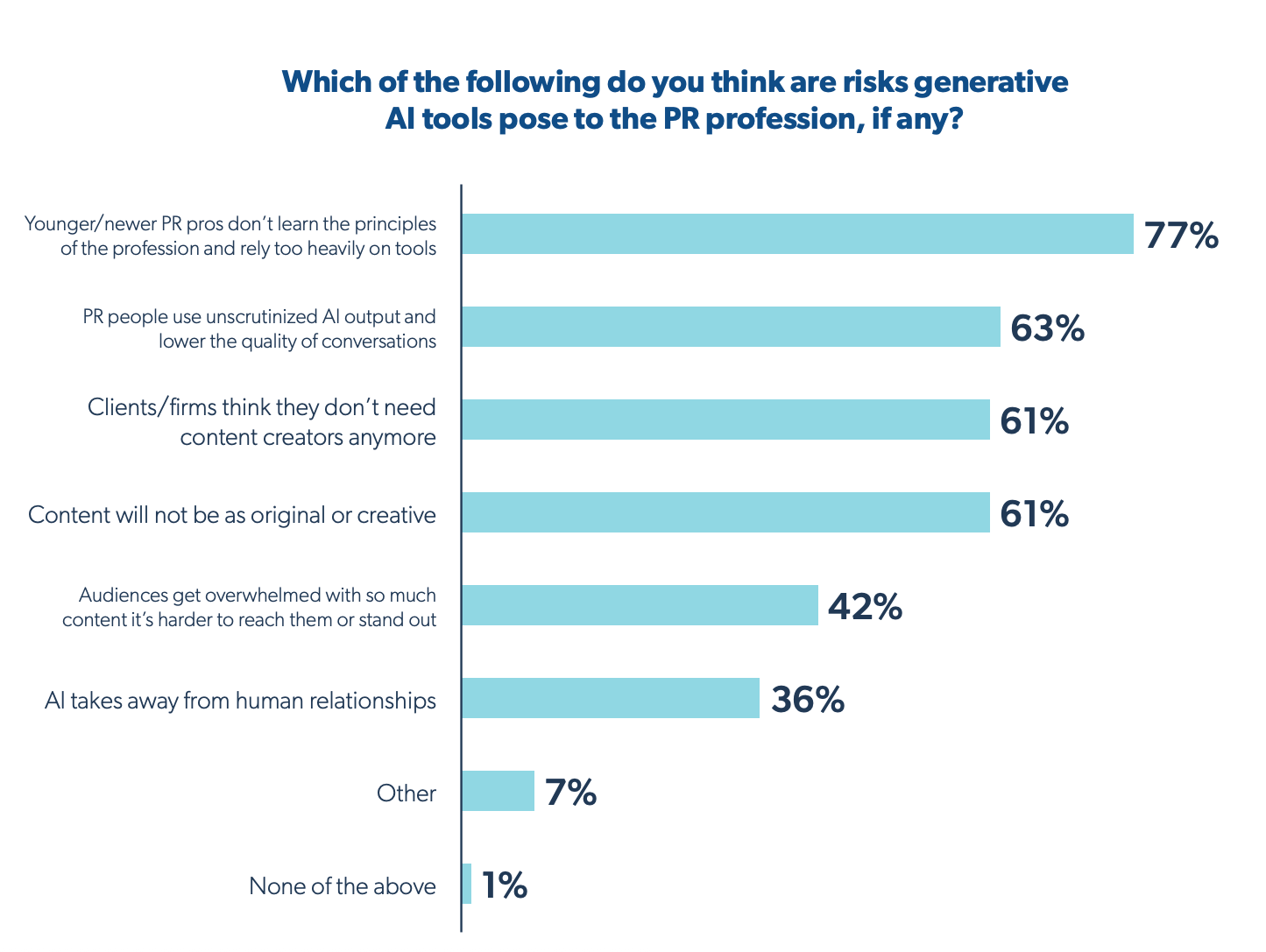
As more organisations use generative AI tools, that’s not to say it doesn’t come without any concerns.
- Younger and newer PR pros not learning the principles of the profession and relying too heavily on AI tools was cited as the biggest concern by 77% of professionals.
- 63% worry that PR professionals will use unscrutinised AI output and lower the quality of conversations.
- 61% fear that clients and firms will think they no longer need content creators anymore, and that content will not be as good or original.
How PR teams are using AI
The previous section shows how more organisations are adopting AI tools and becoming open to the technology, but how exactly are PR teams using AI in their day to day roles? The following digital PR statistics shed some light on this:
- Muck Rack says 38% of PR pros use AI daily to brainstorm ideas, headlines or messaging, while another 39% say they use it weekly.
- Cision reports that 73% of PR pros say brainstorming ideas, campaign concepts, or headlines was the way their team uses generative AI tools the most.
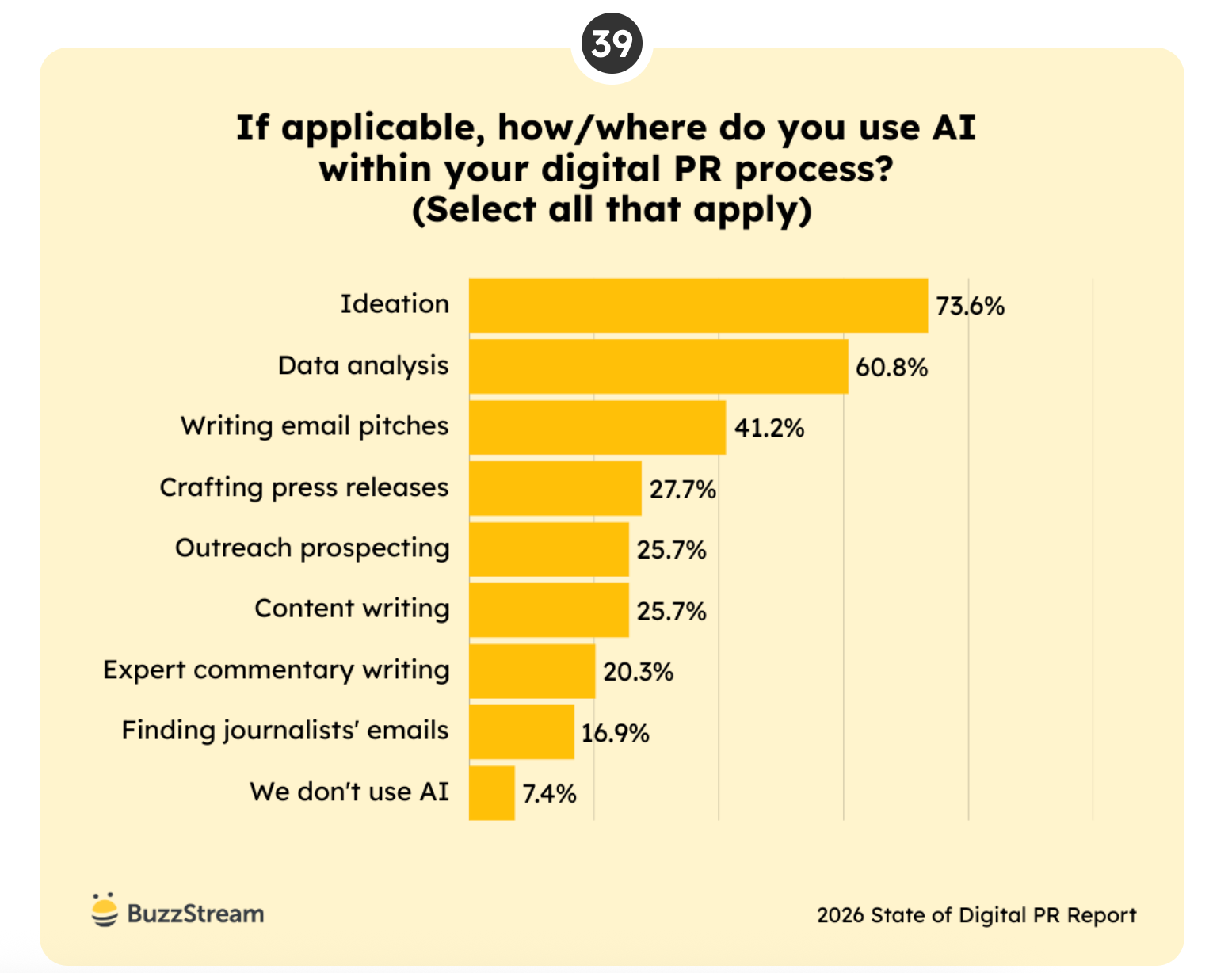
- Ideation (73.6%), data analysis (60.8%), and writing email pitches (41.2%) were the top three ways BuzzStream found AI to be used within digital PR processes.
- Meltwater found that almost half of professionals (49.3%) were using AI tools for social listening, and 29.6% said AI social listening tools had improved their ability to identify rising trends and issues faster.
The impact of AI on PR work
Time saving is one of the biggest impacts cited by PR professionals that AI tools are having on PR work.
- 59% say they save the most time on content creation, 53% say editing, and 46% say research.
- 93% of professionals say AI speeds up work processes overall.
- 82% believe AI increases the quality of their work.
Just over three-quarters of digital PR professionals say AI has fundamentally changed the way they work, yet despite such changes, almost every professional (98%) says they always, or often, have to edit the text generated by AI systems.
28.6% of PR pros have expressed concerns about how AI could reduce the need for human talent in the future, but AI seemingly appears to be a driving force in digital PR in 2026 – 83.1% say digital PR has become more important in the past 12 months in relation to AI.
AI, measurement, visibility, and generative search
One of the biggest AI impacts that we’re seeing in digital PR is the effect it’s having on traditional search. Ranking well in search engine result pages (SERPs) isn’t enough anymore. Content needs to be discoverable and useful to AI systems as well. Google’s AI overview is often the first thing users now see on Google. And large language models (LLMs) like ChatGPT, Gemini, and Perplexity have changed the way people are searching for information online, with 67% of PRs saying they think LLMs will soon become a key part of standard PR measurement.
As we progress through the year, expect more clients to enquire about AI citations in Google overview and LLMs.
- 75% of digital PRs have already been approached about using digital PR to get into AI citations in the last 12 months.
- “Getting mentioned in AI citations” appears as a new category in BuzzStream’s State of Digital PR report, where respondents were asked what digital PR is most effective for. Notably, 66.2% said it’s most effective for securing mentions.
- 78.4% of digital PR pros are already tracking AI visibility for their clients.
Research shows that Reddit is the number one most cited domain across all major AI platforms, accounting for 3.5% of all citations across AI models. It’s the sixth most visited website globally, with 5.1 billion monthly visits. Despite its potential, Reddit is still massively underutilised by PR professionals.
Only 6% of PR pros listed Reddit as the most important tool for social listening. However, Meltwater’s GenAI Lens tool shows it to be a key platform for Generative Engine Optimisation (GEO) efforts, and here at Motive we have had a number of clients mention using Reddit to boost their visibility and online mentions.
An increasing number of industry professionals are posting about Reddit on LinkedIn too, so we expect the platform to continue becoming more prominent throughout 2026.
Statistics on media consumption in 2026
It’s not just AI that has transformed search. Social media platforms have transcended their original function and sites like Instagram and TikTok almost act as search engines now themselves. Younger generations especially are turning to social media as their preferred search method over traditional sites like Google. Consumers are splitting their time across diverse platforms, reducing the reach of traditional mainstream media.
- In the next three years, publishers expect traffic from search engines to decline by more than 40%.
- Around a fifth of publishers who responded to Reuters Institute’s industry survey are expecting a loss of more than 75% of their company’s search traffic.
In the UK, Ofcom’s report on news consumption highlights how audiences are moving towards a variety of online platforms:
- Six in ten UK adults claim they use some form of online intermediary for their news, whether that be social media, a search engine, or a new aggregator.
- Meta (39%) is the most popular service Britons use to access news, followed by Google (34%).
- Facebook is the most-used social media service for news and the dominant Meta platform – reaching 30% of UK adults.
- The influence of TikTok is growing. 11% of UK adults now use the platform for news – up from just 1% in 2020.
- And for the first time, television is no longer the single main source of news for UK adults. 71% of adults now access news online, compared to 70% for TV, marking a generational shift since 2018 when online news consumption was 64%.
Statistics on digital PR and link building in 2026
AI tools and the changes that traditional search is going through are hot topics for digital PR in 2026, but what do digital PR pros think about digital PR and link building itself? The following digital PR statistics help to paint a clearer understanding:
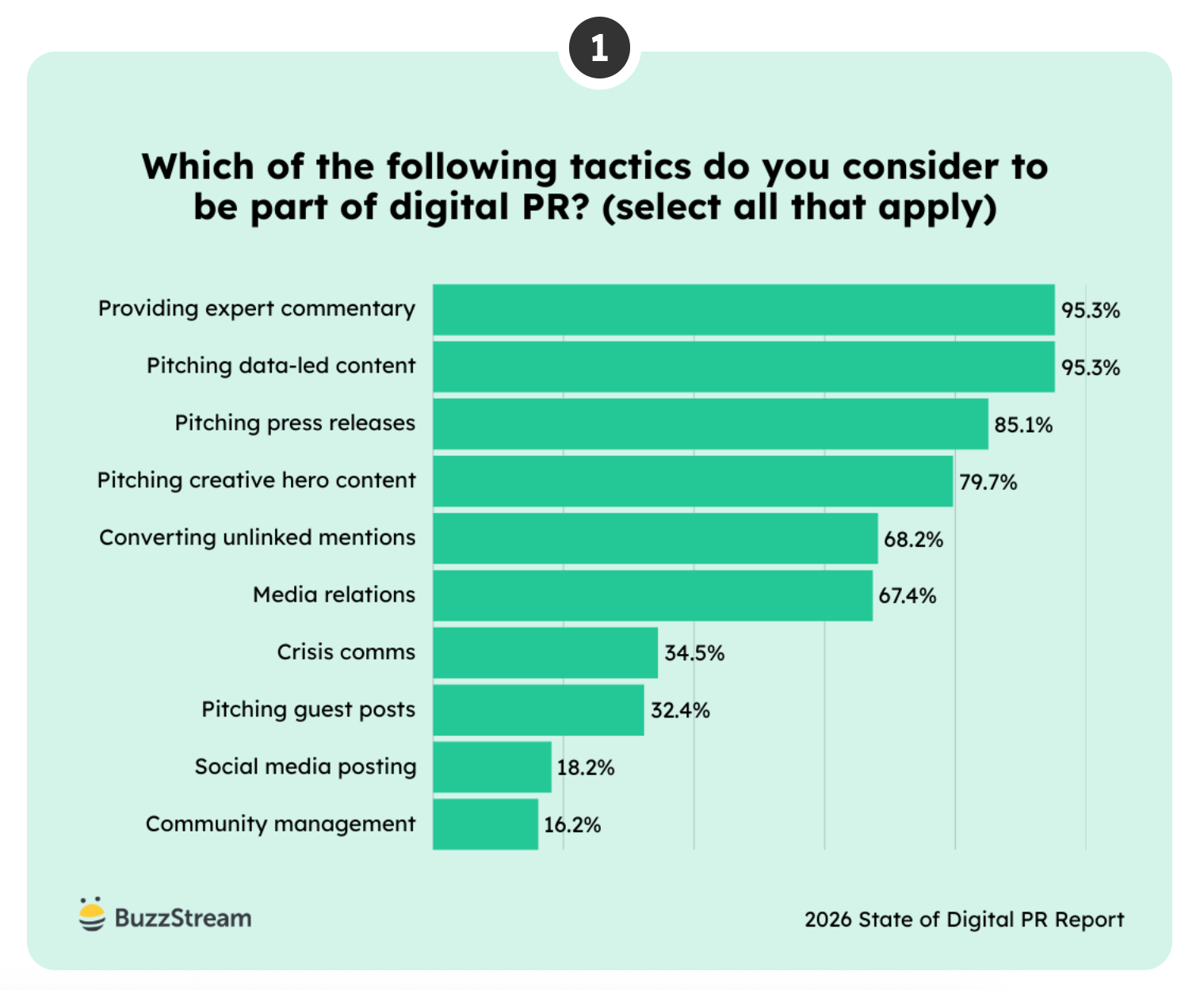
- Digital PR primarily involves providing expert commentary and pitching data-led content, listed by 95.3% of respondents to BuzzStream’s latest PR report.
- Pitching press releases was listed by 85.1% of respondents – a jump from last year's 72.8%.
- Building backlinks remains the most effective use of digital PR (85.8%), followed by building brand awareness and organic traffic.
- 20% of industry specialists cited digital PR as their most successful link building strategy.
- And 68.2% of digital PRs believe that digital PR is more effective now than it was 12 months ago – an increase of about 20% when BuzzStream asked the same question in 2025.
- 59% of PR professionals named “storytelling and content creation” as the core skill that matters most in 2026.
Patience is a virtue when it comes to digital PR. Digital PR isn’t a short-term fix, and should be viewed as a consistent, strategic, and long-term process if you want to see results.
- 85.2% of digital PRs say that it takes no more than 6 months to see measurable results from a digital PR campaign.
- Initial pitches don’t necessarily earn instant coverage. 29.9% of pros say it typically takes 3–5 days to secure coverage after a first pitch.
- But once the results start to come in, momentum builds quickly. 32.5% of digital PRs report that a single team member could generate an average of 31+ links.
Link quality and ranking impact
Although brand mentions are becoming more valuable as AI-generated citations shape discovery and traditional search landscapes shift, backlinks remain one of the most important aspects of SEO. But it’s important to focus on high-quality backlinks as the following digital PR stats show:
- The average Ahrefs Domain Rating (DR) for a piece of digital PR coverage is 61.
- 20.62% of backlinks acquired via digital PR sit between a DR of 70 and 79.
- 87.2% say site relevance is the top evaluation criteria for determining a link’s quality in 2026.
- Closely behind that, 85.8% of digital PRs say third-party page authority metrics such as Domain Authority (DA) and Domain Rating (DR) are best for determining link quality.
- 67.5% of companies believe link building has a substantial impact on search engine results page (SERP) rankings.
- The top Google result has an average of 3.8x more backlinks than the results in 2nd to 10th place.
- Of the 100 top-ranking domains, 92.3% of them have at least one backlink.
- Long-form content gets 77.2% more links than shorter content.
Despite their importance, getting backlinks isn’t always an easy task, and 77% of journalists don’t include links at all when they publish content. Some industries are also harder to build links in than others. 23.6% of digital PR pros say finance is the toughest industry, followed by 20.3% saying health and wellness, and 19.6% citing education. But for those working in travel, it’s once again been named by 46.6% of digital PRs as the easiest industry to gain links in.
Statistics on media relations and the realities of pitching in 2026
Any PR pro will know that securing coverage for a campaign you’ve worked really hard on is a great feeling. But getting that coverage isn’t always so easy. Newsrooms are shrinking, and journalists are incredibly busy, often receiving hundreds of emails each day. So getting your pitch to stand out can be tough.
- 73% of PR pitches are rejected by journalists because they’re not relevant enough.
- 46% of journalists receive 6 or more pitches every day.
- 49% of journalists rarely or never respond to PR pitches.
- 64% of journalists don’t care which day they are pitched to. (Muck Rack)
- More than half of PR agency staff (52%) say less journalists covering industry news is going to be the biggest challenge in media relations and securing coverage in 2026.
The stats are proof that getting a journalists attention is difficult, but there are tactics that can make life easier for PRs:
- 45.9% of PRs find individual 1:1 email pitching to be the most effective method for pitching journalists.
- It’s best to avoid putting a question in your subject line. Digital PR pitches that had a subject line with a question had a 13% lower open rate than those that didn’t.
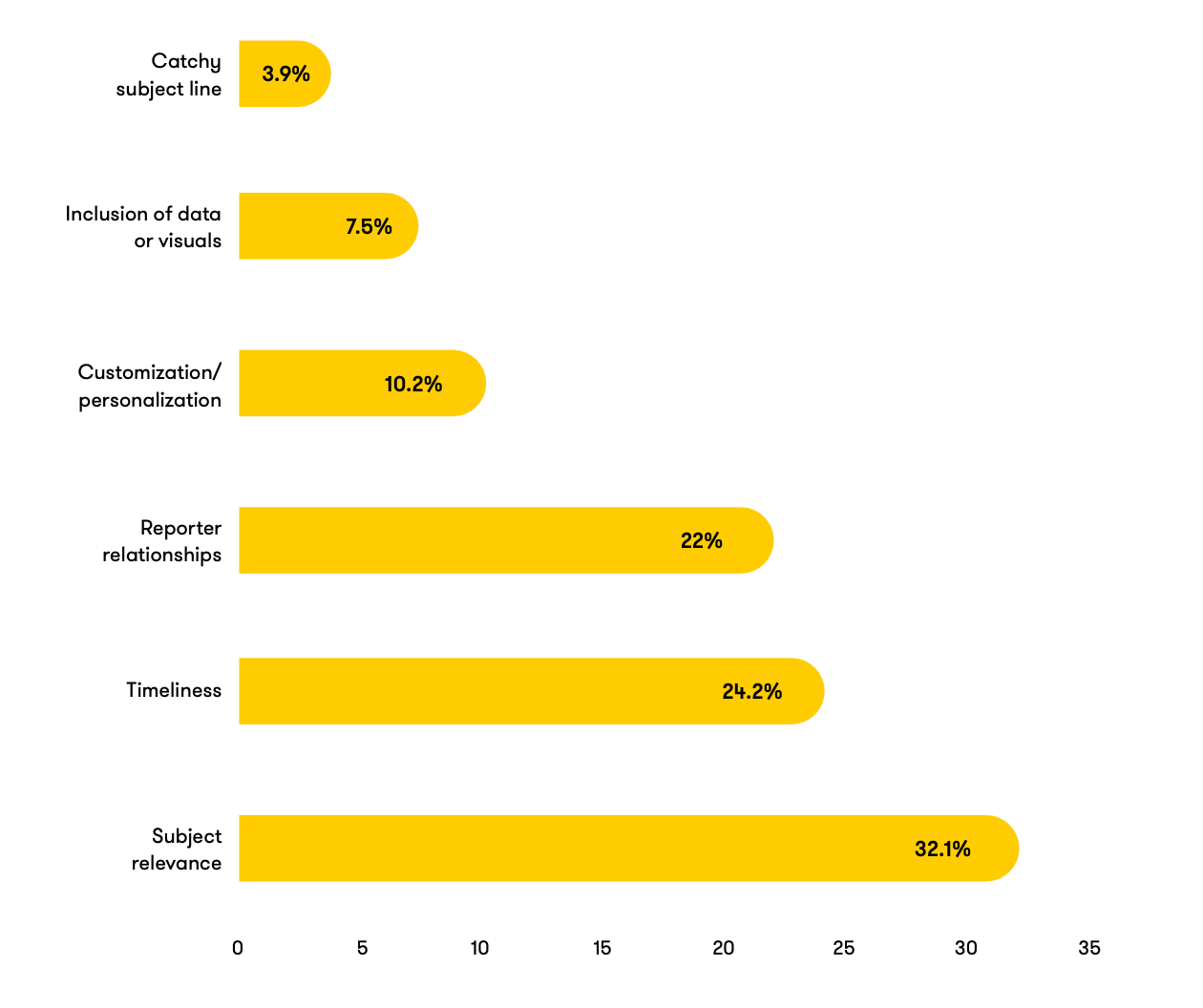
- 32.1% of PRs found subject relevance to be the most important factor for securing coverage.
PR tools for media relations
- Muck Rack is the most-used platform to build media lists (46.6%), followed by BuzzStream (44.6%).
- 62.8% say the main challenge with media list-building tools in 2026 is outdated or incorrect journalist information.
- 56% of digital PRs always verify a journalist’s fit by reviewing their recently published articles.
- 53.4% always verify a journalist’s fit by checking if they are still at the publication before pitching.
- 60.8% of digital PRs say that finding relevant journalists for a campaign has become more challenging in the last 12 months.
Statistics on PR performance in 2026
Measuring success remains one of the industry’s biggest challenges. While securing coverage is still a priority, many agencies and in-house teams are struggling to link their efforts to tangible business outcomes, and three-quarters of digital PRs believe digital PR is more challenging than it was this time last year.
- 52% of agencies and 51% of in-house teams identify linking PR efforts to revenue and business growth as their top challenge.
- Proving ROI beyond vanity metrics was cited by 44% of agencies and 53% of in-house teams as one of their biggest hurdles.
- When it comes to measuring the success of PR efforts, 42% say volume and reach of media placements is the most important metric – showing that much of the industry is still focused on measuring activity rather than outcomes.
- 29% of PR firms cite client investment confidence as a top challenge.
- 35.1% of PR teams report on their PR activities monthly with 21.4% reporting either weekly or quarterly.
- Getting coverage is the number one challenge for digital PR pros (26.4%), followed by measuring impact (14.9%) and keeping up with the changes (14.2%).
- 75% believe digital PR is more challenging than it was 12 months ago.
- 24% say lack of resources is the top PR challenge.
Statistics on the future of PR
As you’d expect, AI and the changing media landscape are cited frequently by PR professionals in their future outlook.
- AI tops the list of skills that 22% of PRs think they’ll need to prioritise over the next 5 years.
- 21.6% of PRs believe navigating new technologies like AI is going to be the biggest challenge for professionals in the future.
- 76% of PR professionals named brand awareness as their top priority for 2026.
- The changing media landscape is the top concern cited by 71% of PR agency teams, followed by 60% citing AI.
- For in-house PR teams, resource pressures is the top concern for 63%, while 49% cite struggling with data-driven strategy demands.
- Only 13% of in-house teams rate themselves as “extremely agile” – less than half of the 29% of agency teams that rated themselves as “extremely agile”.
- 45% of agency pros think communications budgets will be reduced in 2026.
Need help with your PR strategy? Get in touch today to find out more about our digital PR and SEO services.

.jpg)
.jpg)
.png)